
Dead, split, leaning and unwanted trees
Tree Removal in Lubbock, TX
Trees taken down from the top, limbs lowered over roofs and fences, and the wood dealt with the way you want.
- Free visits to quote jobs throughout Lubbock and the South Plains
- You get the price in writing, tree by tree
- We agree on haul-off before day one
When a Tree Has to Come Down
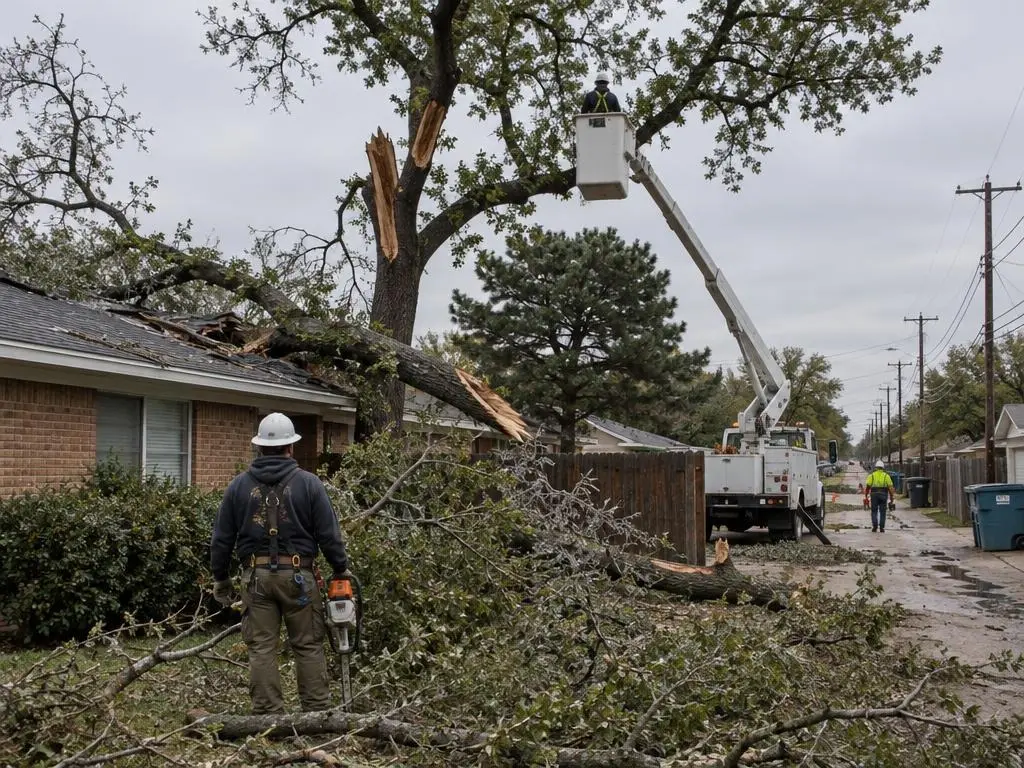
Tree removal in Lubbock usually means taking a tree apart from the top down, not felling it in one piece. Most lots in the city have a house, a garage, a back fence and an alley within reach of any mature tree, and the alley often carries overhead lines as well. So a climber or a lift takes the small limbs first, then larger limbs and sections of trunk, and anything that cannot be dropped safely is lowered on a rope. The height of the tree matters, but access and what is underneath usually decide how long the job takes and what it costs.
Signs a tree is past saving
Some cases are clear. A tree that leafed out thin or not at all after a hard winter, a trunk split down through a fork after a wind event, a cavity or mushrooms at the base, or bark sloughing off in sheets all point to removal. Others are judgment calls: a healthy Siberian elm that has outgrown a narrow side yard, a pine that keeps dropping limbs on the driveway, a tree whose roots are lifting a slab. We tell you what we see and whether pruning or cabling could buy more years instead.
Root rot and sudden decline
Texas root rot is a soil fungus that favors exactly the alkaline, calcareous soil found across the South Plains. It attacks almost 2,000 kinds of broadleaf plants, including pecans and many ornamental trees, and once leaves start to yellow and wilt in summer heat a tree can be dead in about two weeks. A tree killed that fast often still looks full from the street. The danger is underneath: rotted roots no longer anchor it, and the next strong wind can push the whole tree over. If a tree has wilted suddenly in July or August, have it looked at before the next blow.
Siberian elm and other short-lived trees
Siberian elm was planted across the Plains for shelterbelts after the Dust Bowl because it grows fast and tolerates drought and cold. It also has brittle wood and a poor crown, and it is usually short-lived, often dying before 60 years. Many older Lubbock-area yards and fence lines have big ones, often with dead tops and long cracked limbs. These are some of the most common removals we quote.
Working off the alley
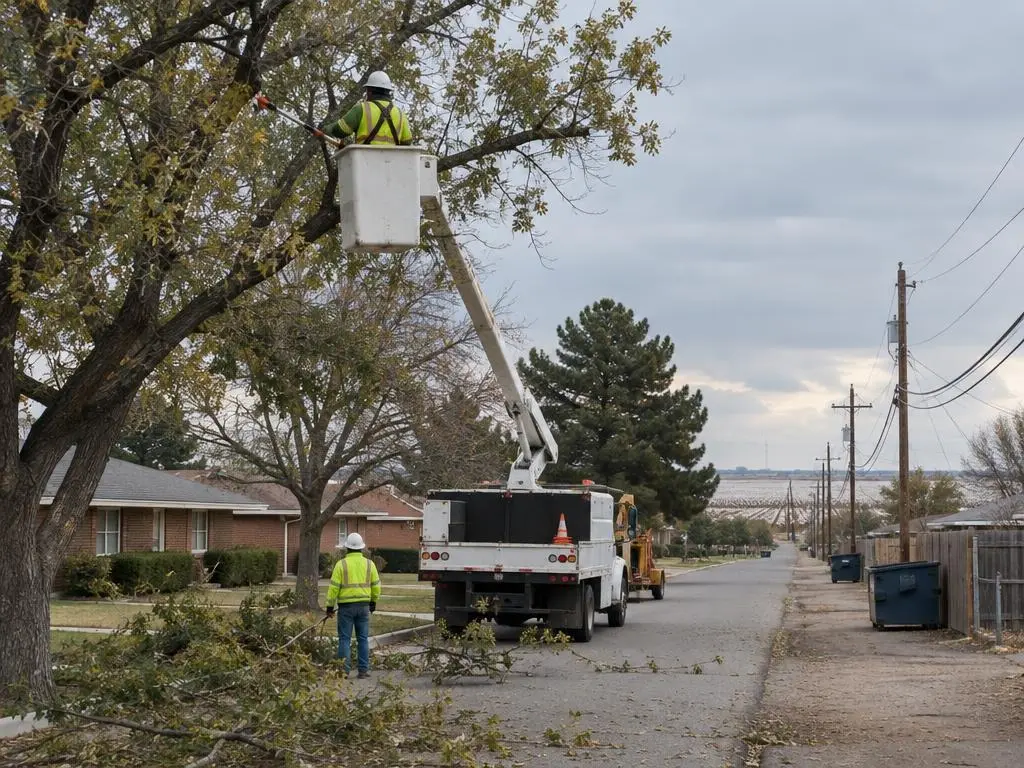
The alley is often the easiest way to get a chipper close to a backyard tree, but it is also a public right-of-way with lines overhead and dumpsters in the way. We plan the job so the alley stays usable as much as possible and nothing is left blocking it; city code treats obstructions in streets and alleys, including things like firewood racks, as a nuisance. If a limb is within ten feet of high-voltage lines, the utility handles that part first.
What happens to the wood
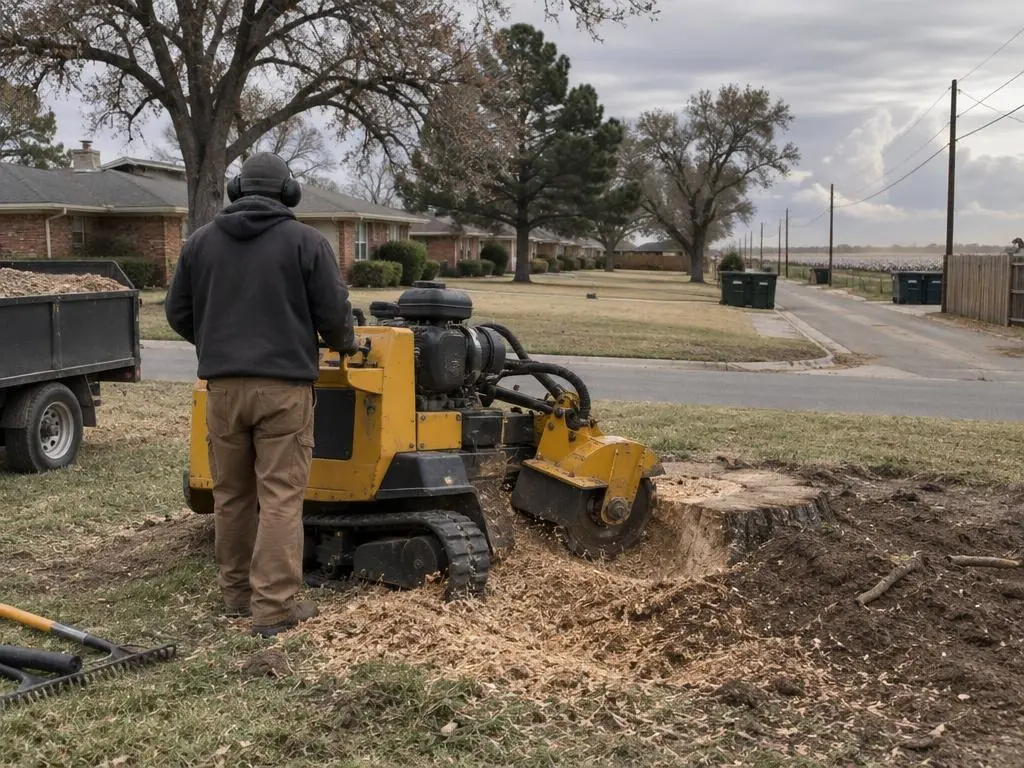
You decide. Logs can be left in rounds, cut to firewood length or hauled off, and brush can be chipped with the chips left as mulch or taken away. The city's landscape waste page notes that tree crews may not use residential city dumpsters and must take material to the landfill, so haul-off is priced on its own line. The stump is a separate line too; grind it now or later.
What Tree Removal Covers
A removal includes taking the tree down and dealing with everything that comes off it.
Sectional takedown
Limbs and trunk sections removed from the top down, with heavy pieces lowered on ropes over roofs, fences and alleys.
Dead and declining trees
Trees killed by root rot, drought, freeze or years of elm leaf beetle damage, taken down before the wood gets more brittle.
Storm-split trees
Trunks split through a fork or leaning after wind or ice, removed before the rest of the tree comes down on its own.
Brush chipping
Branches fed through a chipper on site, with chips left for bed mulch or hauled away.
Log handling
Wood left in rounds, cut to firewood length, stacked where you want it or removed from the property.
Typical Tree Removal Costs
| Job | Published range |
|---|---|
| Small tree, under 30 ft (HomeGuide) | $200 to $500 |
| Medium tree, 30 to 60 ft (HomeGuide) | $500 to $1,500 |
| Large tree, 60 to 80 ft (HomeGuide) | $850 to $2,000 |
| Pine (HomeGuide) | $250 to $1,600 |
| Oak (HomeGuide) | $300 to $2,500 |
| Crane, when needed (Forbes) | adds $250 to $600 per day |
| Stump grinding added on (HomeGuide) | $100 to $500 per stump |
National ranges from HomeGuide (2026) and Forbes Home (updated 2025); we have not found a reliable Lubbock-specific survey. Tight backyard access, trees over roofs or lines, and dead wood raise the price. Your written estimate is the price.
How a Removal Goes
1. Walk the site
We look at the tree's condition, what is under it, the lines, and whether the street or the alley is the better way in.
2. Written quote
The method, the cleanup, the stump and the price for each tree, in writing, before anything is scheduled.
3. Take it down
Small limbs first, then larger limbs and trunk sections, with rigging wherever a piece cannot simply drop.
4. Leave it tidy
Brush chipped, wood handled as agreed, alley cleared and the yard raked and blown out.
Why Choose Us for Tree Removal
Pruning considered first
If thinning or reducing a tree would fix the problem, we say so before quoting a removal.
Alley kept usable
Work off the alley is planned so trucks and neighbors can still get through, and nothing is left in the right-of-way.
Tree Removal Questions
How much does tree removal cost in Lubbock?
National guides put most removals between about $400 and $1,200, with small trees under 30 feet from about $200 and large trees from $850 to $2,000 or more, according to HomeGuide's 2026 figures. Big trees in tight backyards with lines in the alley sit at the top of those ranges. We give you a written price after seeing the tree.
Do I need a permit to remove a tree on my property in Lubbock?
We have not found a city permit requirement for removing a tree from a private single-family lot. Commercial and multifamily properties built under the city's landscape rules must replace a credited tree within 180 days if it dies or is removed. If you live in an HOA, check its rules before the tree comes down.
Is a dead tree harder to remove?
Often, yes. Dead wood dries out and can snap unpredictably, so climbing it and lowering pieces takes more care, and some dead trees are safer to take down from a lift than by climbing. HomeGuide notes that dead trees often cost more than expected for that reason. Taking a declining tree down before it is fully dead is usually easier.
Can you remove a tree next to the power drop to my house?
Usually, yes, by lowering limbs away from the service line. If any part of the tree is within ten feet of the high-voltage lines on the poles, Lubbock Power and Light says only utility-authorized crews may prune there, so call LP&L at 806-775-2509 first. We take down the rest once it is safe.
Will you take the wood and brush away?
If you want. Haul-off is a separate line on the quote, because tree crews have to take material to a landfill rather than use the city dumpsters. You can also keep the wood as rounds or firewood and the chips as mulch.
Tree Removal Service Areas
- Tree Service in Lubbock, TX
- Tree Service in Wolfforth, TX
- Tree Service in Shallowater, TX
- Tree Service in Idalou, TX
- Tree Service in Slaton, TX
- Tree Service in Ransom Canyon, TX
- Tree Service in Buffalo Springs, TX
- Tree Service in Abernathy, TX
- Tree Service in New Deal, TX
- Tree Service in Lorenzo, TX
- Tree Service in Ralls, TX
- Tree Service in Levelland, TX
- Tree Service in Tahoka, TX
- Tree Service in Wilson, TX
- Tree Service in Smyer, TX
- Tree Service in Ropesville, TX
- Tree Service in Anton, TX
- Tree Service in Woodrow, TX
- Tree Service in Reese Center, TX
- Tree Service in New Home, TX
- Tree Service in Petersburg, TX
Get a Tree Removal Estimate
Free on-site estimates for tree removal in Lubbock.